Upper Mount Royal Architecture — Tudor, Georgian, and Modern Estate Homes
Upper Mount Royal's luxury homes span Tudor Revival, Georgian, Foursquare, mid-century bungalows, and modern estates. Here's how each style shapes renovation cost, systems, and value.

# Upper Mount Royal Architecture — Tudor, Georgian, and Modern Estate Homes
What architectural styles define Upper Mount Royal's luxury homes?
Upper Mount Royal is one of the few Calgary neighbourhoods where you can walk a single block and pass a 1912 Tudor Revival, a symmetrical Georgian, a 1960s bungalow, and a brand-new modern estate. That mix is the point: the district has been continuously desirable for more than a century, so each era layered its own architecture onto the hill. For luxury buyers, understanding these styles — and what each one means for renovation cost, systems, and resale — is the difference between buying a home and buying a project.
By Spencer Rivers — Calgary Luxury Real Estate Specialist | August 7, 2026
---
Upper Mount Royal doesn't have a single look. That's exactly what makes it interesting to buy in — and occasionally confusing to shop.
Unlike a newer community where a developer set the architectural tone in one build-out, Upper Mount Royal has been Calgary's address of choice since 1904. Every decade since has added homes, and the result is a streetscape that reads like a timeline of Alberta residential architecture. For a buyer, knowing which era you're standing in front of tells you a great deal about what's behind the walls.
Here's the field guide I give clients touring the neighbourhood — the styles you'll see, what each one is really like to own, and where the value tends to sit. This is a companion to my broader Upper Mount Royal and Elbow Park buyer's guide, which covers pricing, flood exposure, and how the two heritage districts compare.
The early-century character homes — Tudor, Georgian, and Foursquare
The neighbourhood's founding architecture dates to the 1910s and 1920s, when the hill was subdivided for Calgary's professional class. These are the homes that give Upper Mount Royal its heritage identity.
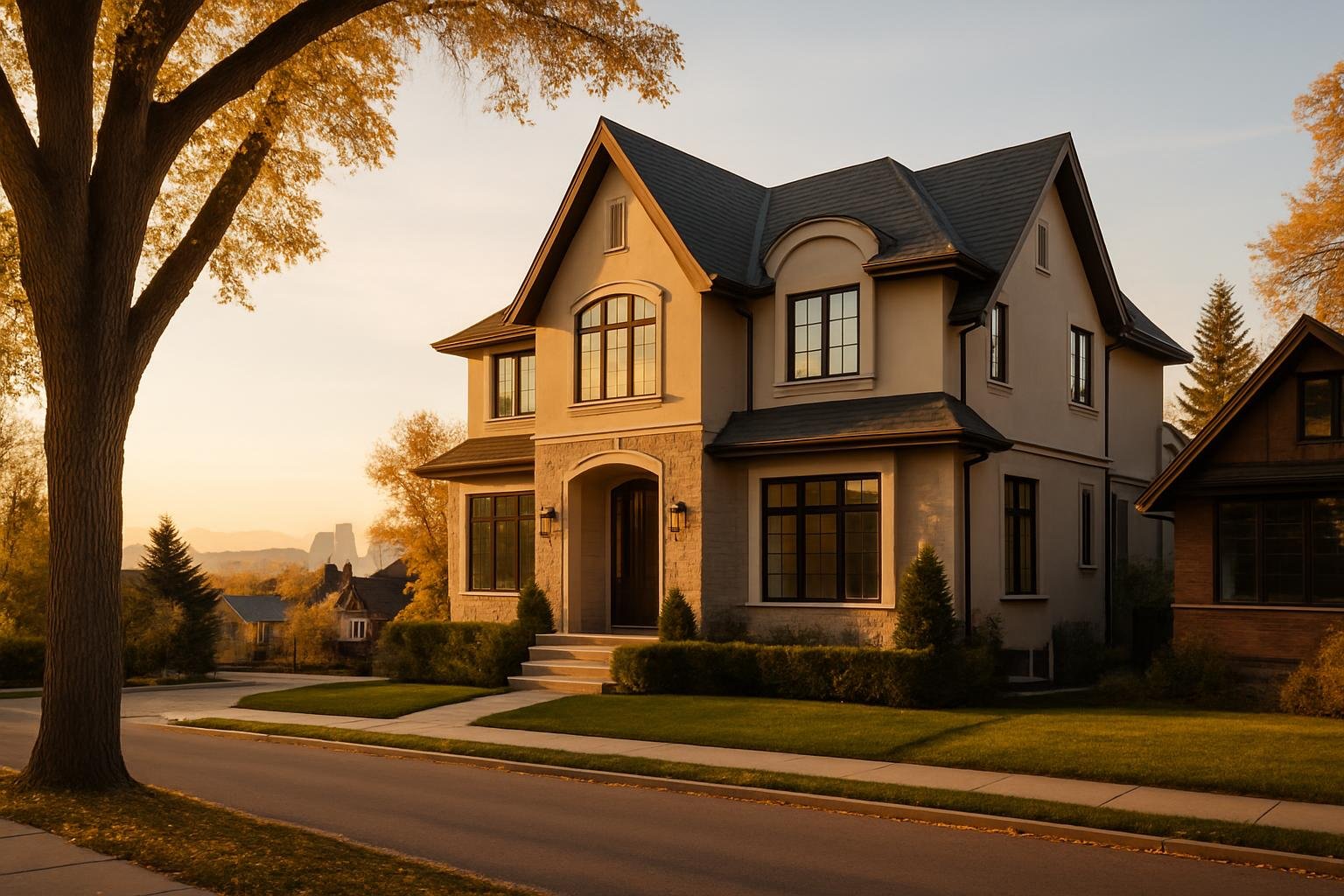
Tudor Revival is the signature. Steeply pitched roofs, decorative half-timbering, tall narrow windows, and prominent brick or stucco chimneys. A well-preserved Tudor on a mature, tree-lined lot is one of the most sought-after looks in the district, and buyers pay a premium for an authentic one.
Georgian and Colonial Revival homes bring symmetry — a centred front door, evenly spaced windows, and formal proportions. They tend to read more restrained and stately than the Tudors, and they suit buyers who want classic elegance over storybook character.
Foursquare homes are the practical workhorses of the era: boxy, two-and-a-half storeys, hipped roof, generous front porch. Many have been beautifully modernized inside while keeping their solid, square footprint.
What these homes share is genuine craftsmanship — plaster walls, real hardwood, solid millwork, and proportions that new builds struggle to replicate. What they also share is age. Before you fall for one, verify the systems: electrical (knob-and-tube or aluminum wiring still exists in some), plumbing, the foundation, and the heating plant. A stunning restoration and a cosmetic flip can look identical in photos and differ by hundreds of thousands of dollars in the walls. This is the exact scenario my guide on renovating versus rebuilding in Mount Royal is built to help you work through.
The mid-century homes — bungalows and split-levels
Move through the 1950s, 60s, and 70s and the architecture shifts. Ranch bungalows, raised bungalows, and split-levels filled in lots and replaced some earlier homes.
These homes are often bought less for their architecture than for their land. A solid 1960s bungalow on a wide Upper Mount Royal lot is frequently valued close to lot value — the buyer is purchasing the parcel and the location, with the existing house as either a renovation candidate or a future teardown.
That said, well-executed mid-century modern homes have their own following, and a tasteful renovation of a period bungalow — vaulted ceilings, walls of glass, an open plan — can be a genuinely desirable end product rather than a stepping stone. The key question on any mid-century home here is simple: are you buying the house, or are you buying the dirt? The answer changes how you should price it and what you should pay.
The modern estates — new builds and full custom homes
The newest layer is the modern estate. Over the past fifteen-plus years, infill builders and custom-home clients have replaced aging homes with contemporary residences: clean lines, large windows, open-concept main floors, triple-car garages, and current mechanical and smart-home systems.
These homes sit at the top of the neighbourhood's price range for good reason — you get century-old-street setting with zero-compromise modern construction. No knob-and-tube, no foundation surprises, no dated systems. For many executive and out-of-province buyers who want the prestige of Upper Mount Royal without a renovation, a modern estate is the obvious fit.
The trade-offs to watch: build quality varies between builders, so verify who built it and how; and a very contemporary home on a heritage-heavy block is a resale consideration worth thinking through, though Upper Mount Royal's demand generally absorbs a wide range of styles.
How architecture drives value here
A few patterns hold across the district:
- Authentic, well-preserved character homes command a premium for their heritage appeal — but condition and systems drive the real number underneath.
- Mid-century homes often trade close to land value; price them on the lot, not the finishes.
- Modern estates sit at the top of the range, priced for turnkey construction on a premium setting.
- Lot width, position, and view cut across every era — a great lot lifts every style, and a view lot lifts it further.
Because the same street can hold four eras of architecture at four different price logics, pricing and offer strategy in Upper Mount Royal is genuinely local knowledge. Two homes with similar list prices can represent completely different value depending on whether you're buying craftsmanship, land, or turnkey construction. If you're on the selling side, my guide to pricing a luxury listing walks through how these distinctions shape the number.
Frequently Asked Questions
What is the most common architectural style in Upper Mount Royal?
There's no single dominant style — the neighbourhood spans Tudor Revival, Georgian and Colonial Revival, and Foursquare homes from the 1910s–20s, mid-century bungalows and split-levels, and contemporary modern estates. Tudor Revival is the most iconic of the heritage styles and a big part of the district's identity.
Are Upper Mount Royal's heritage homes protected or designated?
Some individual homes carry municipal heritage designation, which can affect what you're permitted to alter, but most are not formally protected. Never assume — confirm a specific home's heritage status before planning a renovation or rebuild, since it materially affects your options.
Is it better to buy an older character home or a new build in Upper Mount Royal?
It depends on your appetite for renovation and what you value. Character homes offer irreplaceable craftsmanship and setting but need careful due diligence on systems and foundation; modern estates offer turnkey construction at the top of the price range. On a premium lot, a rebuild sometimes makes more financial sense than restoring — a decision worth running with an agent who knows the block.
Why do some Upper Mount Royal homes sell for close to land value?
Many mid-century bungalows and split-levels are valued primarily for their lot and location rather than the existing house, so they trade near land value as renovation or rebuild candidates. On the neighbourhood's wide, well-positioned lots, the parcel itself is often the main asset.
The bottom line
Upper Mount Royal's architecture is its history made visible — Tudors and Georgians from the founding era, mid-century bungalows bought for their lots, and modern estates built for buyers who want the setting without the renovation. Reading which is which, and what each means for cost and value, is the core skill of buying well here.
When you're ready to tour Upper Mount Royal with someone who can tell the restorations from the cosmetic flips at a glance, I'd be glad to help. Reach out at luxuryhomescalgary.ca/lets-connect.
---
About Spencer Rivers — Calgary Luxury Real Estate Specialist Spencer Rivers is a luxury real estate agent serving Calgary and the surrounding Calgary Metropolitan Region. With over $200M in career sales and designations including CLHMS, CIPS, and Million Dollar Guild membership, he specializes in helping buyers and sellers navigate Calgary's luxury market — from estate homes in Springbank Hill and Upper Mount Royal to luxury condos in East Village and Eau Claire. Connect with Spencer at luxuryhomescalgary.ca.
REALTOR® at Rivers Real Estate · Synterra Realty. Spencer represents buyers and sellers across Calgary's luxury communities — Springbank Hill, Aspen Woods, Upper Mount Royal, Elbow Park, Britannia, and Bel-Aire.