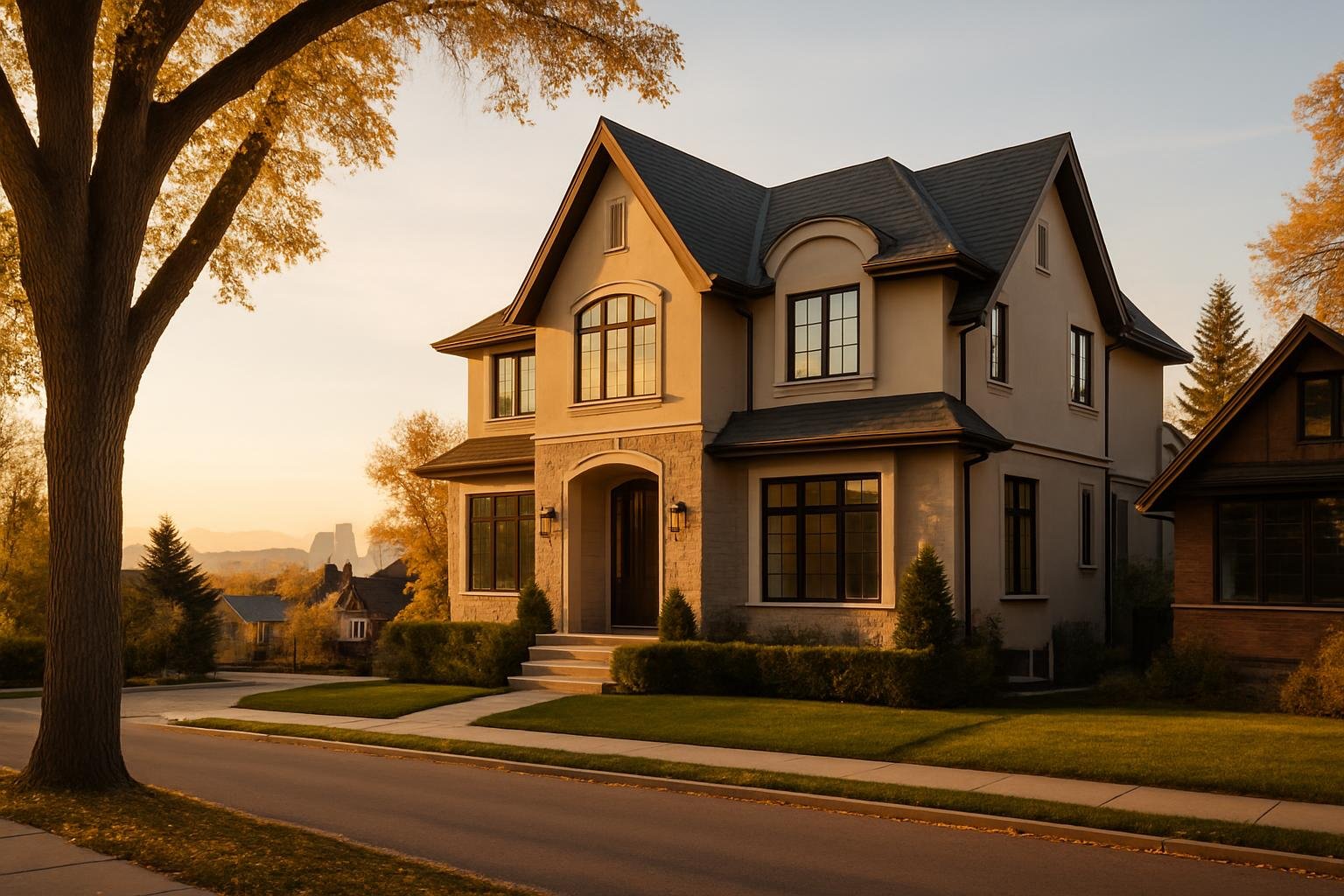
Britannia Real Estate — Estate Lots, Mid-Century Homes, and Rebuild Economics
Britannia real estate splits into three tiers: 1950s originals at land value ($1.7M–$2.4M), renovated homes ($2.4M–$3.5M), and new estate builds ($3.5M–$6M+). Here's the lot data and the rebuild math.

What does Britannia real estate actually consist of, and does a rebuild pencil?
Britannia real estate is a pool of fewer than 300 detached homes on estate-scale lots in inner-city southwest Calgary. The stock splits into three tiers: original 1956-to-mid-1960s bungalows and split-levels that trade largely at land value ($1.7M–$2.4M in 2026), renovated or expanded mid-century homes ($2.4M–$3.5M), and new custom estate builds ($3.5M–$6M+). Lots typically run 55 to 65 feet wide by 120-plus feet deep, with wider corner, curve, and escarpment parcels along Britannia Drive. A rebuild usually pencils only if you buy the lot near land value and budget $500–$750 per square foot above grade for construction — which puts a finished 4,500-square-foot home at roughly $5M–$6M all-in, against resale values that currently support it.
By Spencer Rivers — Calgary Luxury Real Estate Specialist | September 16, 2026
Britannia buyers ask me one question more than any other once they've fallen for the neighbourhood: should I buy the bungalow and build, or pay up for something finished?
It's the right question, because the answer decides what you're actually shopping for. In Britannia, an original 1958 bungalow and the new estate home beside it can be separated by $3M, and the gap is land, construction cost, and time — not mystery. This post lays out the three tiers of Britannia real estate, what the lots really give you, and the rebuild math the way I run it with clients before they write an offer.
For the wider picture — location, amenities, how Britannia compares with Elbow Park and Bel-Aire — start with the Living in Britannia buyer's guide. This is the property-level deep dive that sits under it.
The Lots — Where Britannia's Value Is Stored
In most inner-city Calgary neighbourhoods you buy a house that happens to sit on a lot. In Britannia it's closer to the reverse. The land carries the value, and the house on top is a bonus, a project, or a demolition line item.
The original 1956 plan drew roughly 50-foot frontages, but Britannia was laid out on curved streets rather than a grid. Curves produce irregular lots, and the result is that most Britannia parcels are 55 to 65 feet wide and 120 feet or more deep, with corner and inside-curve lots that run wider or come out pie-shaped. Against the standard 50-by-120 lot across the river in Altadore or Marda Loop, that's 20 to 40 percent more land on a typical interior parcel — and it's what makes a triple garage, a wide front elevation, and a real backyard fit on a rebuild.
Three lot categories matter when you're pricing:
- Interior lots. The baseline. Flat, rectangular or gently irregular, and straightforward to build on under standard City of Calgary development permit rules.
- Corner and curve lots. Wider frontage and more flexibility in garage placement. A modest premium on the land, a larger premium on the finished home.
- Escarpment lots. The parcels along Britannia Drive and the western edge that back onto the Elbow River slope. They carry the views and the district's highest values, but the City requires geotechnical slope-stability review where slopes exceed 15 percent, and the buildable envelope is set by an engineered setback from the crest — not the lot line. A 140-foot-deep escarpment lot can have a shallower usable pad than a 120-foot interior lot.
One more note on land: Calgary's 2024 citywide rezoning moved the default residential district to R-CG, which permits semi-detached and rowhouse forms. Britannia's lot values keep a single estate home the highest and best use on nearly every parcel, but confirm the land-use designation on any specific property before you buy rather than assuming.
The Three Tiers of Britannia Homes
Walk a block of Coronation Drive or Imperial Way and you'll see all three generations side by side. Here's how each one prices and what it's really selling you.
Tier one — original mid-century homes (1956 to mid-1960s). Bungalows and split-levels, low and wide, in brick and wood siding with attached garages and big picture windows. Usually 1,500 to 2,400 square feet above grade with a developed basement, a 1990s or 2000s kitchen refresh, and original mechanicals behind the drywall. In 2026 these trade at roughly $1.7M to $2.4M, and the price is set by what a builder will pay for the lot — not by the kitchen. Britannia's median sale over the past two years has sat right around $2M, and this tier is most of that volume.
Tier two — renovated and expanded homes (1990s to 2010s work). Second-storey additions, pushed-out rear walls, opened-up interiors. From the inside some read as new; from the foundation up they're 1950s houses with new skin. Roughly $2.4M to $3.5M, with the spread driven by the quality and age of the work and whether the floor plan reads as designed or as a sequence of add-ons. This is the tier where a Calgary luxury home inspection earns its fee many times over — original foundations, mixed-era plumbing, and additions tied into 60-year-old framing are exactly where a report finds something material.
Tier three — new estate builds (roughly 2008 to today). Custom homes of 3,500 to 6,000 square feet, contemporary or transitional, triple garages, and finish levels at home in any luxury market in the country. From about $3.5M to $6M and up, with escarpment view homes on Britannia Drive setting the ceiling. New builds here routinely close above $4M.
The number that matters is the gap between tier one and tier three on the same street — $2M to $3.5M. That's what a rebuild has to cost less than to make sense.
Rebuild Economics — Does the Math Work in 2026?
Here's how I run it with clients on a typical interior lot.
The land. Buy an original bungalow for $2.0M. Add Land Titles registration, legal fees of roughly $1,500 to $3,000, and carrying costs while you plan — no land transfer tax in Alberta, which helps. Call it $2.05M in.
Demolition and site. Demolition, utility disconnects, and site preparation typically run $40,000 to $80,000, more with asbestos abatement in a 1950s home (assume some) or a tree protection plan.
Construction. A realistic 2026 budget for a custom build at the level Britannia buyers expect is $500 to $750 per square foot above grade. On 4,500 square feet that's $2.25M to $3.4M, before basement development, landscaping, and the driveway — budget another $250,000 to $400,000 for those on an estate-scale lot.
Soft costs and time. Architecture, engineering, permits, builder margin, and construction financing interest over an 18-to-24-month build: another $150,000 to $300,000.
GST. A newly built home is subject to 5 percent GST — on construction inputs for an owner-build, on the full price for a builder-sold spec home. Either way it's a six-figure line and belongs in the pro forma from day one.
On mid-range assumptions, a 4,500-square-foot custom home on a $2M Britannia lot lands between $5M and $6M all-in and takes two years from purchase to move-in. Against tier-three resale values of $4M to $6M, the math works — but it works more comfortably on an escarpment or wide corner lot, or when you're building to hold for a decade rather than to sell. On a narrow interior lot with a full builder margin, you can end up owning a $5.2M house where the comparable resale is $4.6M.
The alternative is buying a well-executed tier-two home at $3M and skipping the two years. The trade is that a renovated 1950s house will always carry a resale discount to a new build — in Britannia, often 20 to 30 percent on comparable square footage — which is why most owners at the top of the market build rather than renovate. I walked through the same fork for the district next door in Renovating vs Rebuilding in Mount Royal, and the conclusions transfer almost unchanged.
Two things separate a rebuild that pencils from one that doesn't: buying the lot close to true land value, and holding the construction budget. Get the first one wrong and the second can't save you.
Before You Write the Offer
Because you're usually buying land, the condition period should be built around what you can do with the lot, not just the state of the house. Confirm the land-use designation in writing. Get a builder's site assessment during conditions if a rebuild is the plan. Order geotechnical review on any escarpment lot before conditions are waived. And read the Real Property Report line by line — on Britannia's irregular lots, encroachments, unpermitted decks and retaining walls, and fence lines that don't match the survey are common finds.
Most importantly, price the home you're buying, not the one you're imagining. On a tier-one purchase the seller may be pricing the lot; on a tier-two purchase they may be pricing a renovation a builder would remove. Comparable sales in the right tier are what the offer should rest on, and how to make a winning offer on a Calgary luxury home covers deposit, conditions, and possession timing that lines up with a demolition permit.
If you're selling a Britannia original rather than buying one, the same logic runs in reverse: your buyer pool is builders and owner-builders, and pricing to land value rather than to the kitchen is what gets it sold. And if you're comparing against my older Britannia neighbourhood guide, the lot data still holds; pricing, zoning, and construction budgets have all moved.
Frequently Asked Questions
How much is a lot worth in Britannia, Calgary?
In 2026, original 1950s homes on interior Britannia lots sell for roughly $1.7M to $2.4M, and at that level the price is effectively the land value. Wider corner and curve lots carry a modest premium, and escarpment lots along Britannia Drive with river-valley views are the most expensive land in the district, though their buildable area is limited by engineered slope setbacks.
How much does it cost to build a house in Britannia?
A custom luxury build at the finish level Britannia buyers expect runs about $500 to $750 per square foot above grade in 2026, before demolition, basement development, landscaping, soft costs, and GST. A 4,500-square-foot home typically lands between $5M and $6M all-in including a $2M lot, and takes 18 to 24 months from purchase to move-in.
Is it better to renovate or rebuild a mid-century home in Britannia?
For most owners at the top of the market, rebuilding wins. A renovated 1950s home in Britannia typically resells at a 20 to 30 percent discount to a comparable new build, and the original foundation and mechanical layout limit what a renovation can achieve. Renovating makes sense when the home is a well-preserved mid-century design worth keeping, or when you plan to hold long-term without regard to resale.
Can you build a duplex or rowhouse in Britannia?
Calgary's 2024 citywide rezoning moved most residential land to the R-CG district, which permits semi-detached and rowhouse forms. In practice, Britannia lot values make a single estate home the highest and best use on nearly every parcel, and escarpment lots face additional slope constraints. Confirm the current land-use designation on any specific property before you buy.
The Bottom Line on Britannia Real Estate
Britannia sells land first and houses second. The three tiers — original, renovated, new build — are three different purchases with three different buyer pools, and the rebuild math works when you buy the lot near land value, budget construction honestly, and pick a lot whose geometry supports the home you want.
Every version of this decision comes down to a specific lot, a specific budget, and a specific builder. If you're weighing a Britannia original against a finished home and want the numbers run on a real property, I'm glad to do that with you. Reach out at luxuryhomescalgary.ca/lets-connect.
About Spencer Rivers — Calgary Luxury Real Estate Specialist Spencer Rivers is a luxury real estate agent serving Calgary and the surrounding Calgary Metropolitan Region. With over $200M in career sales and designations including CLHMS, CIPS, and Million Dollar Guild membership, he specializes in helping buyers and sellers navigate Calgary's luxury market — from estate homes in Springbank Hill and Upper Mount Royal to luxury condos in East Village and Eau Claire. Connect with Spencer at luxuryhomescalgary.ca.
REALTOR® at Rivers Real Estate · Synterra Realty. Spencer represents buyers and sellers across Calgary's luxury communities — Springbank Hill, Aspen Woods, Upper Mount Royal, Elbow Park, Britannia, and Bel-Aire.